
Why three visible Scatters may fail an eligible-reel trigger
Published — UTC

A trigger that names eligible reels must be counted inside those reels. Three Scatter symbols somewhere on the screen cannot prove that three qualifying Scatters are present if the rule restricts the area.
Make the invented restriction visible
Assume a five-reel example whose stated trigger requires one Scatter on each of reels 1, 2 and 3. Scatters on reels 4 and 5 do not count toward that trigger. This rule is invented and must not be applied to a named slot.
| Reel | Scatter visible? | Eligible for this trigger? |
|---|---|---|
| 1 | Yes | Yes |
| 2 | No | Yes |
| 3 | No | Yes |
| 4 | Yes | No |
| 5 | Yes | No |
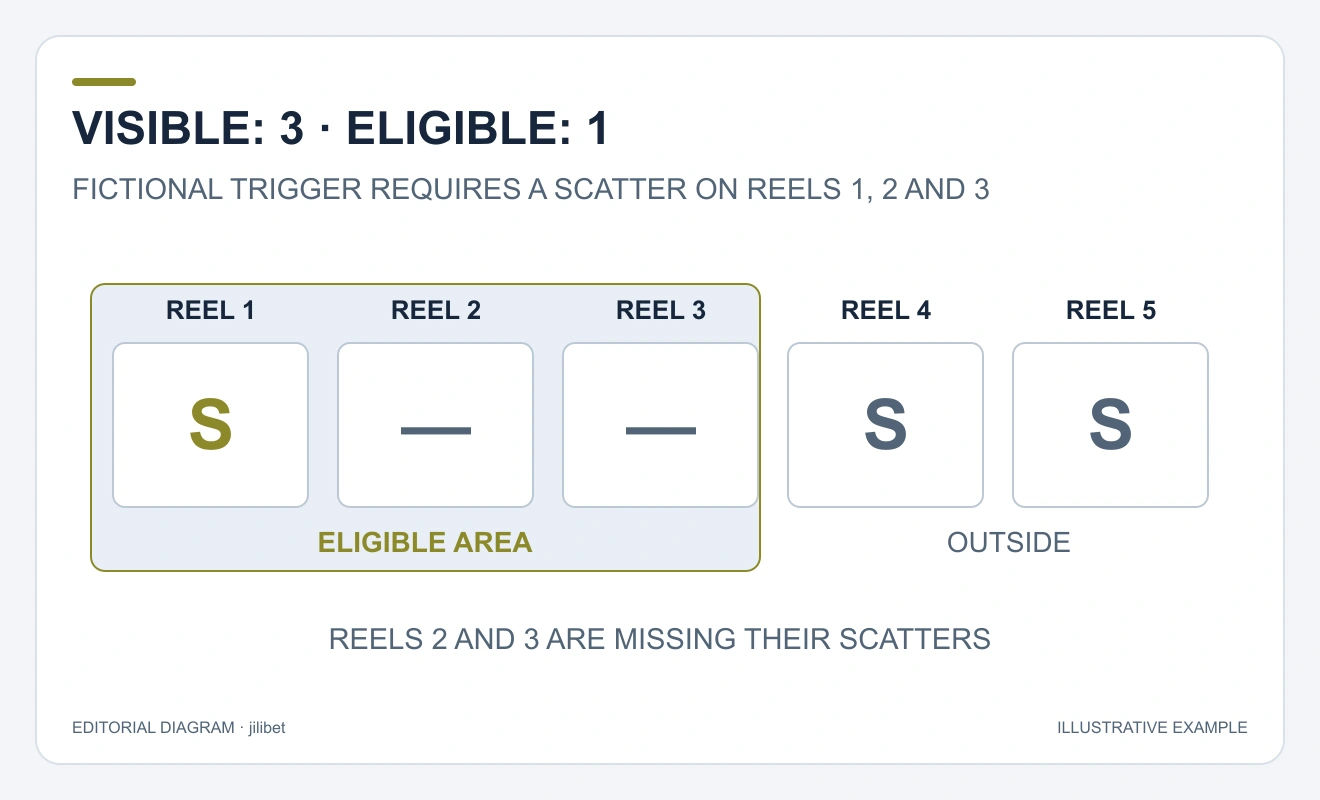
The whole screen has three Scatters. The eligible area has one, and the required reels 2 and 3 are missing theirs. The example does not trigger. Counting every visible Scatter answers the wrong spatial question.
“Three anywhere” would be another rule
If the wording instead accepted any three Scatters across all five reels, the same image could pass. If it required three on distinct eligible reels, two symbols on one reel would not necessarily supply two required reels. Preserve the wording; do not reduce all three instructions to the number 3.
The British game-description reference concerns explicit winning conditions. It does not verify an edition’s eligible reels.
A compact screenshot check
Label the reel numbers, mark the accepted area, and count only symbols allowed by the actual mode’s rule. Then test any distinct-reel or position requirement separately. Record a missing rule as unknown rather than inferring it from an animation.
Count symbols and occupied reels separately
A second fictional layout contains two Scatters on reel 1 and one on reel 2. Its symbol count is three, but its occupied-reel count is two. Under “three anywhere” it passes the numerical threshold, assuming all those positions are eligible. Under “three distinct reels” it does not. Under “one on each of reels 1, 2 and 3” it also fails because reel 3 is missing.
That distinction is useful when a tall reel can display more than one special symbol. Record both quantities: three symbols; two distinct reels. Do not turn “three Scatters” into “three reels” unless the documented instruction makes that connection.
Check which trigger the screen is describing
A base-game entry rule and a free-spin retrigger rule may use different thresholds or accepted positions. Save the exact game title, edition, active mode and relevant rule panel together with the settled reel image. A promotional banner or cropped celebratory frame cannot establish those conditions.
If the visible symbol resembles a Scatter but has another label, verify its role in the legend. Bonus symbols, collection symbols and ordinary paying symbols should not be treated as interchangeable because their artwork looks similar. This step identifies the input before any counting begins.
A conclusion someone else can reproduce
For the first diagram, a complete note reads: “Three Scatters visible at reels 1, 4 and 5. Rule requires one on each of reels 1, 2 and 3. Only reel 1 qualifies; reels 2 and 3 are absent; trigger not met under that rule.”
If the rule panel or final settled image is missing, keep the conclusion open. The aim is to explain a documented trigger, not to infer a malfunction, a hidden reward or the next result from three symbols alone.