
GUIDE · jilibet
Two bingo patterns can share a square without guaranteeing two prizes
A completed row and a completed column can overlap on one bingo card. That gives two recognizable patterns, but it does not automatically establish two prize payments. First count the positions; then read how the game treats those patterns in the relevant stage.
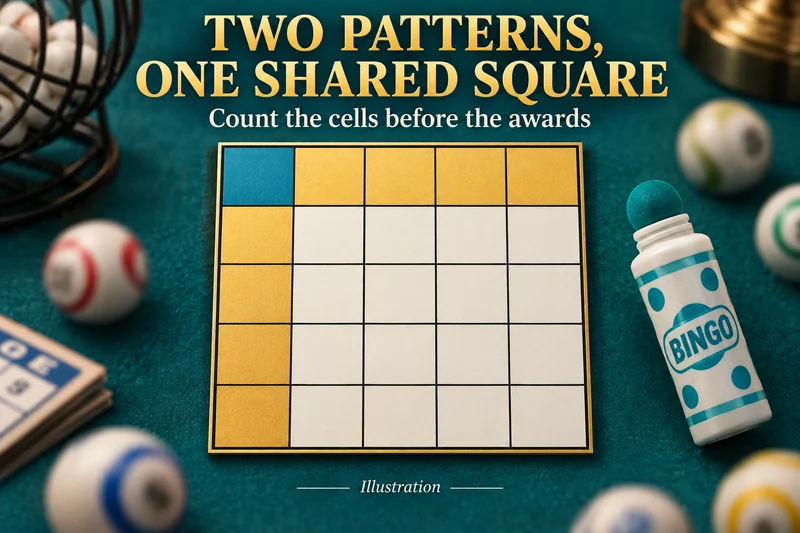
A card you can check square by square
Imagine a five-by-five teaching card with no free square. Mark every cell in the top row and every cell in the leftmost column. We use positions rather than printed numbers because the purpose is to show overlap, not reproduce a ticket or a draw.
The top row contains five marked cells. The column also contains five. The top-left corner belongs to both, so adding five and five counts that corner twice. The number of distinct marked cells is 5 + 5 − 1 = 9.
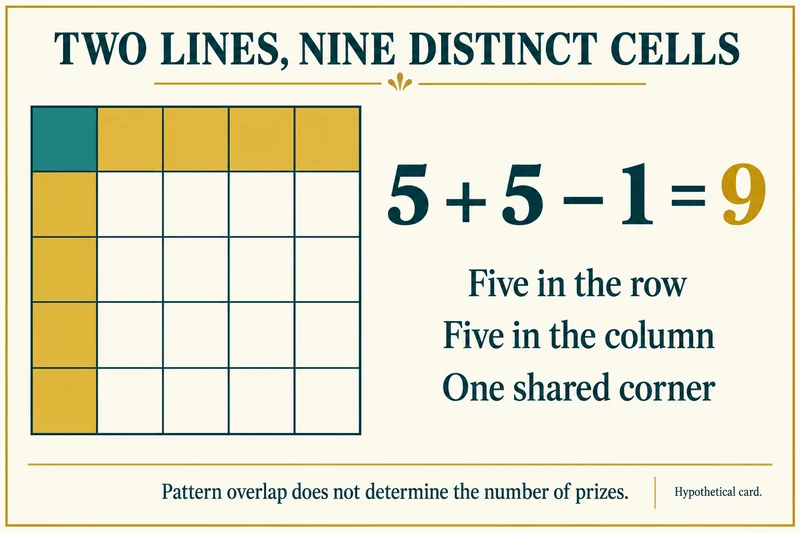
You can check it another way: count all five cells across the top, then the four remaining cells below the corner. Five plus four gives the same nine. No additional marked cell is created merely because the corner completes two shapes.
Three records to keep separate
| Record | What we know | What remains dependent on the rules |
|---|---|---|
| Marked positions | Nine distinct cells in the illustrated arrangement | Whether the actual card and calls are valid |
| Visible patterns | One complete row and one complete column | Whether these are qualifying patterns at this stage |
| Awards | No amount established by the drawing alone | Which awards apply and whether they combine |
The same card can meet different invented award policies
Consider two purely hypothetical rules. Policy A pays one award when any eligible line is complete, with a maximum of one such award per card. Policy B separately awards each eligible completed line. Our drawing may show the same two shapes under both policies, yet the award counts would differ if all their other conditions were met.
There could also be a stage condition: a game might currently evaluate one particular pattern rather than every shape visible on the card. These examples illustrate missing information. They do not claim that a named bingo product follows any of these policies.
Find the winning-condition text
The UK Gambling Commission’s RTS 3, which includes bingo in its scope, calls for understandable rules and descriptions of winning outcomes. It is a useful explanation of why the prize condition belongs beside the picture; it does not verify a local product.
For a real record, preserve the card identifier, applicable pattern diagram, stage and award-combination wording. If a screenshot omits that context, the visible shape is only part of the evidence. Our screenshot context guide develops that source-checking step, while the number-game hub covers ticket identity. Return to the jilibet overview for the wider library.
Source checked 8 October 2026. Original positional diagram and fictional award policies; no ticket, bingo draw or prize claim was tested.
AI-assisted source research and original explanation. No gameplay, payments or operator-availability testing was performed. Sources checked 2026-10-08.