
Bingo coverall: 24 marked numbers can complete 25 positions
A 75-ball coverall card with a free centre has 25 positions but only 24 printed numbers. Completing it requires those 24 numbers to be called. It does not mean the card must finish on the twenty-fourth call of the game.
Calls that belong to other cards still advance the game’s call count. That is why “numbers marked on this card” and “balls called in the round” need separate columns.
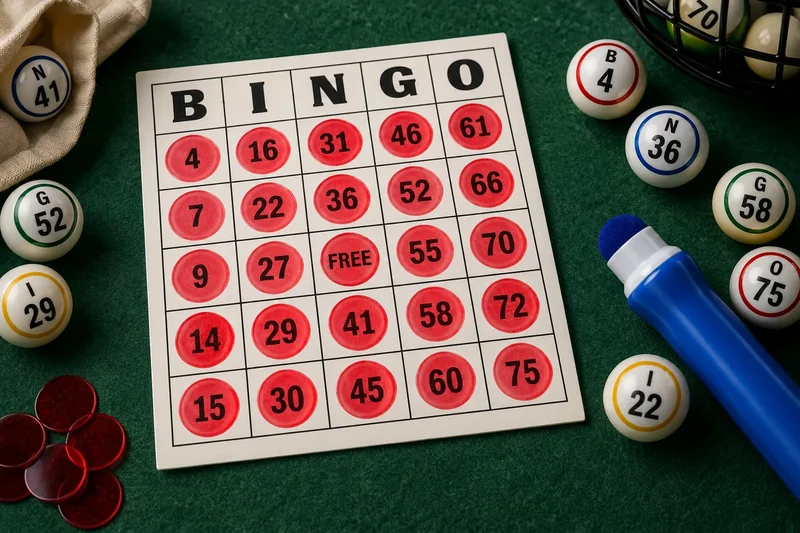
Name the card format first
Mecca’s explanation of 75-ball bingo describes a free middle position and a coverall of all 24 numbered squares. We use that format for this paper exercise. A card with no free centre or a different announced pattern needs a different count.
The free centre contributes one covered position immediately. It contributes zero called numbers. Adding it to both columns would invent a ball that never existed.
Follow one card through an invented call record
| Stage | Calls in the round | Different numbers on this card called | Covered positions including FREE |
|---|---|---|---|
| Start | 0 | 0 | 1 |
| Later snapshot | 30 | 18 | 19 |
| Another snapshot | 50 | 23 | 24 |
| Next qualifying call | 51 | 24 | 25 |
At 50 calls, one numbered square remains uncovered. If the next call is that number, the card reaches coverall at call 51. The record contains 24 matching calls and 27 other calls. There is no contradiction in 24 numbers taking 51 calls to appear.
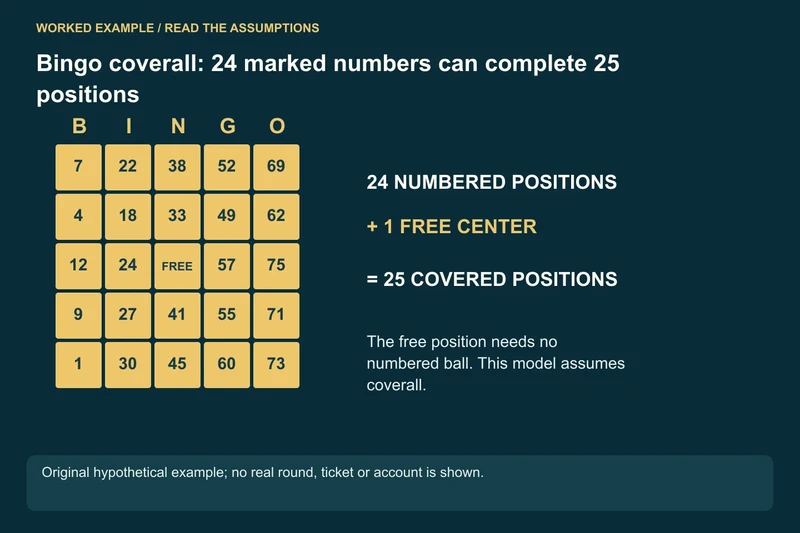
Why total marks elsewhere do not complete the card
Suppose a second card has the missing number already marked. That does not fill the first card’s empty cell. Coverall is tested on one identified card, against its own printed numbers. Nor can a second announcement of a number already marked fill a different missing square.
A useful final check is to list the unmarked numbers, rather than repeatedly count all the marks. When that list contains one number, the exact missing value is clearer than “almost a full card.” It still says nothing about when that value will be called.
A complete pattern and a valid award remain separate
This worksheet establishes the geometry and arithmetic of the assumed coverall. Actual eligibility also depends on the round, valid ticket, announced pattern and game procedure. A picture of 25 coloured cells does not supply those facts.
For a saved record, retain the full card and call history with their identifiers. Label a missing history as missing rather than reconstruct it from the finished picture. Counting correctly helps explain a record; it does not predict the next call or justify purchasing another card.
The jilibet homepage brings together the site’s other reading topics.
Source-based editorial research and original examples. Sources checked 9 October 2026. No real-money play or account transaction was performed for this article.